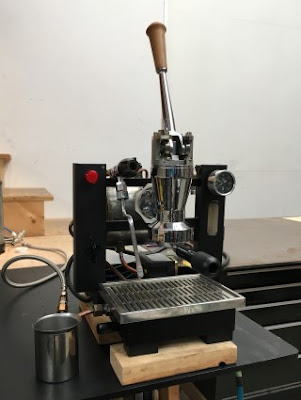
At the end of last week I received the prototype of the group body from the foundry. There was a little confusion with the shipping and the package got left on the doorstep of my office overnight! Very fortunately, despite spending the night on a busy street, it was still there the next morning. I have taken quite a few measurements and, although there are a couple of small problems, I am very pleased with the result. I put the new body into my stripped-down machine with the rest of the original group parts to limit the scope of the testing. The first results were a little worrying: even after a good warm-up, there was a constant flow of water past the lower piston seal. I took a closer look at the piston and decided to replace both seals, which, though they were working fine in the old group, are a couple of years old. Success - no more water past the seal. My suspicion, though I haven't tried to measure this yet, is that there is a certain amount of error in the alignment of the cylinder bore with respect to the top of the group. If the axis of the bore isn't perpendicular to the surface that the rest of the group parts are bolted to it will mean that the axis of the piston wont be parallel with the axis of cylinder. It also makes sense that a pair of cylinder and piston parts that have lived together for decades would generate a unique wear pattern on the seals. I may also add a PTFE (Teflon) guide ring to the piston which will greatly increase the concentricity of the piston with respect to the cylinder.
Finding a good fit for the portafilter seal was another small adventure. The groove for the seal has a couple of out-of-tolerance dimensions which will have to be addressed in the next production run. This means that there is less space (both axially and radially) than is needed for the generic 73mm x 57mm x 9mm Viton seal. To solve the problem for now I found an 8mm silicon seal for another machine (rancilio silvia i think) which is considerably softer and fits quite nicely.
To make a a long story short: I made coffee on Friday. With old beans and without re-calibrating the grinder the results were actually pretty good. Now that the body has been tested, I can start on the rest of the group parts.
The first casting from the foundry! The square block at the top is the riser which provides a reservoir of molten metal that is drawn into the casting as it solidifies and shrinks. There seems to be a few slight dents in the cast, likely the wax pattern was dinged before it was put into the investment. They should come out in the polishing, though are couple are pretty deep. Now it is off to for machining.

This leads me to a discussion of the material. This is a functional prototype made from a brass alloy similar to C69400, which is not an ideal material for a couple of reasons. The first is that the lead content likely exceeds allowable levels (0.3% in the US). The second is that C69400 has no additives to prevent (or rather retard) dezincification, the process whereby the zinc is stripped from the metal leaving a weak and brittle copper sponge which can ultimately lead to failure of a part at pressure. Dezincification resistance is especially important for espresso machines because of the operating temperature, the acidity of coffee and often, due to the use of water softeners, the mild salinity of the water itself.
From the excellent copper.org website:
[i]Sand-cast faucets and other plumbing components have traditionally been made from leaded red, semi-red and yellow brasses. The most common plumbing brass, C84400 (also known as 81 Metal or 81-3-7-9) contains nominally 7% lead. The most popular red brass, C83600 (85 Metal, 85-5-5-5), contains nominally 5% lead. Permanent mold and pressure die castings of plumbing components are also commonly made of the leaded yellow brass alloy C85800, which contains nominally 1.5% lead.[/i]
Lead is added to brass to improve machinability. It acts as a lubricant and causes the chips to break into small pieces while it is being cut. Worse still, because of the way the lead crystals form as the liquid metal solidifies in the mold, the concentration of lead is highest at the inside surface - i.e. where it comes into contact with the water. The unfortunate conclusion is that it is highly likely that both my machines (and indeed all vintage espresso machines), help me meet my recommended daily dose of lead in the morning. This was just the way things were was until California passed its law in 2006. Since then, considerable effort has been made to find alternatives to leaded brass.


